
While you take your first sip of morning coffee, you find yourself reaching for the vape in your pants pocket, only to feel an empty void that now accompanies the dissatisfaction filling your brain. You drive to work, and almost subconsciously take the first exit that leads you to your favorite vape shop or gas station where you can soon enough feel the relief of exhaling that all-too-familiar cloud of smoke.
We’ve all heard of dopamine. The chemical in your brain that signals you to repeat a behavior that was perceived as rewarding or motivating. Dopamine isn’t just friends with “pleasurable” behaviors. Going for a run can be absolutely grueling and boring, but if the resulting consequence is feeling less anxiety and having a more positive body image, then you might be more motivated to go for a run again another day. What you perceive as rewarding might not be the same as for someone else.
When our brain is expecting the satisfaction of biting into an oreo, or having a glass of wine when coming home from work, some dopamine (DA) is released inside the reward processing center inside of our brains. Drugs and non-drug rewards differ in how much of that DA is released, and for how long it’s released. There is a huge surge in release after taking Adderall, a smaller surge from cocaine, and an even smaller surge from caffeine and sugar.
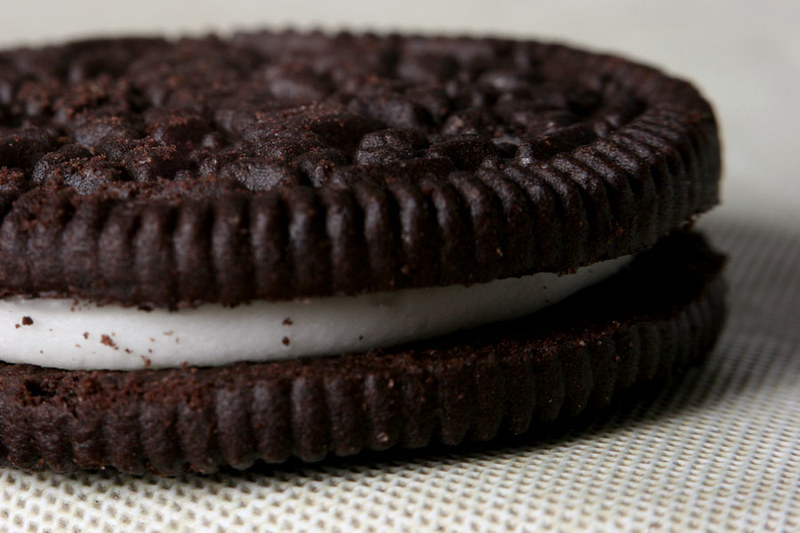
Even seeing a photo of an oreo makes me crave one!
The more frequently you take drugs, which release more DA than would otherwise be released with natural rewards, the more dampened your reward system gets. Consequently, over time you will find natural rewards like healthy food and social relationships less rewarding. I say healthy food because junk food (fatty and sugary) will be much more rewarding than a salad. This dampened motivation is also accompanied by a negative emotional state (stress, anxiety) that begins to creep in when you don’t have the drug in your system. A hangover from a night out drinking can actually be thought of as “acute withdrawal,” where your stress system is on overdrive to try to compensate for the dysregulation in the DA system.
Each time you vape, DA is quickly released once nicotine reaches the brain. It doesn’t stick around for long, however, so that DA release is very short-lived. Even in anticipation of vaping, some DA is released. If your brain doesn’t get that expected hit, the absence of DA will make you start craving it, driving you to take that next hit. Many other things can exacerbate this craving, including stress, hunger, and loneliness.
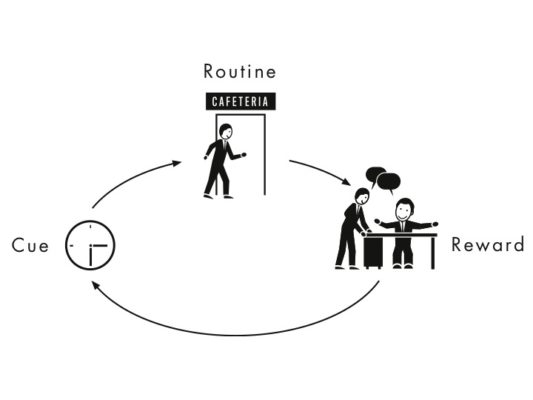
Simple habit loop, credit to The Power of Habit by Charles Duhigg.
In this example, the time of day, such as the early afternoon (cue), tells the man that it is time to go to the cafeteria to get lunch (routine). The reward (or resulting consequence) is getting food, knowing he will get a break to chat with his friend.
Each time your brain pairs a cue with a behavior, or a behavior with some consequence, a connection is made and then strengthened with repetition. There can be many cues paired with a given behavior. Maybe you vape with your morning cup of coffee, so you have a visual cue (coffee) and an internal cue (time of day) paired with the behavior of vaping. Maybe you vape often with a certain friend, or in a certain environment like your car. Over time the cues gain enough salience, or importance, that they can act alone to elicit craving that behavior associated with the DA release.
Think of training a dog to respond to your command: at first it learns that when you say “sit” it will be given a treat, until eventually just saying “sit” without that treat will elicit that behavior, since your dog has learned to expect the treat! If you stop giving your dog a treat sometimes after doing the behavior, it will soon enough forget what it learned. Learning is much quicker when the reward immediately follows the cue-behavior pair, and when the brain expects to receive that reward after doing the behavior a certain # of times. DA release from vaping nicotine is very quick, and happens 100% of the time, versus the time it takes to complete a work assignment or household chore that might give you a sense of accomplishment.
So, a key to breaking the habit of vaping is to reduce the strength of the associations made between all of those different cues paired with your vaping. This is difficult, especially when considering the frequency and duration of your vaping. Maybe keep some fidget toy in your pocket to help calm that subconscious urge to reach into your pocket while you’re taking a bathroom break. If you were vaping all day at no specific time, maybe limit yourself to short pockets of time during which you can vape. Over time the original associations you made will be less reinforced and decrease in strength.
Going from vaping 24/7 to not vaping at all will make you feel miserable, in part because your brain is starving for DA and in result you will feel anxious, stressed, irritable, with little motivation for much. For some people it might work best to just get through this difficult hump. For others, it might help to go slowly and sprinkle in rewards for small improvements in behavior, like a cupcake when you’ve gone X amount of time without vaping. And start to engage more in behaviors that naturally boost DA. Exercise, especially if you perceive it as rewarding, is one great way to relieve cravings if done regularly. Spending time outdoors in natural light, adequate sleep, and eating protein-rich foods have also been shown to increase DA production and release.
Take a look at the ~3-min video below on how muscle memory gets encoded in our brains. How new connections are created and strengthened with skills like learning to play basketball is in the most simplistic sense the backbone of habitual behaviors like vaping and can help understand how to “unlearn” a habit.
To break a habit, you have to increase the friction, or barriers, to engaging in that habit. And what works for someone else might not work for you. There are many factors not discussed in this post that play a role in habits and decision making – comorbid mood disorders, attention, memory, self-control, nutrition, exercise, social relationships, mindfulness, and even sleep. For instance, even one night of sleep deprivation tends to make us more prone to engage in habitual behavior over goal-directed behavior.
My next post will focus on how you can more easily quit vaping, or drinking, or any other habit that has been engrained in your brain that you’d like to quit, or at least reduce the frequency of.
I would love to hear about your experience with trying to quit vaping, drinking, or some other substance. Does any of what you read above resonate with you? Have any questions? Comment below!
2 responses to “Why is it so hard to quit the vape?”
-
This is very valuable information, I appreciate you sharing it with the public. I think we all know people who have unhealthy addictions and would really benefit from reading this. It makes me think about how a lot of Americans are addicted to things – will we never not be addicted to something? Does our capitalistic culture make us more prone to seek dopamine hits? I think most of my loved ones are addicted to something – whether it be work, working out, love, reality television, food, alcohol, nicotine, cannabis, etc. Are we all just craving that extra dopamine because of what you shared – examples being the lack of human connection or fulfillment? It almost feels like, as humans, we are neurologically compelled to seek rewards. Is this an evolutionary trait? To be deprived and then finally get a reward after a long time scavenging or hunting for food? I guess the only thing we can do is replace unhealthy behaviors with healthy ones. It’d be nice, though, to be content with just being.
I so appreciate your bringing awareness and attention to this topic, especially during a time when addiction rates are at their highest.LikeLike
-
Thanks for your comment ccdubrin! I think you’re spot on with how our capitalistic culture is basically taking advantage of how dopamine drives our behavior. A couple of examples: food corporations unnecessarily add sugar into food knowing that we will seek out that same kind of food again; media platforms like TikTok that deliver quick boosts of dopamine by delivering entertaining content that is catered to what has given you pleasure in the past. I think there are so many behaviors that our society as a whole is doing less of today that normally would give us that normal level of dopamine release we need to thrive. Those behaviors range from seeing daylight (we spend SO much time indoors), doing exercise (avg American moves something like <4,000 steps/day), social connection (this is HUGE), to eating natural food. I think to move towards a healthier society we need to start with our children. I’m not a parent just yet and I can completely understand that when you’re exhausted nothing seems more satisfying than giving your child a tablet to play with or putting on a TV show for them, but if this is done regularly, your child is learning that it will get a quick “fix” to being cranky, tired, etc. Boredom is good for children (and us adults!) and that is where creativity sprouts from, but I think we have all been driven to find quick fixes to most of our problems and that is where I believe a large part of the issue lies. It would be amazing, as you said, if we could instead learn to be “content with just being,” which requires being mindful of our thoughts and emotions and not always just run away from them.
-


 tuneinjuntos.com
Leave a comment